Infolinks In Text Ads

Sponsor

Showing posts with label Internet. Show all posts

Tuesday, October 18, 2022

Ukraine Starlink Satellite Internet Is Now In Danger

Earlier this year, SpaceX has been bolstered Ukraine’s war effort with about 20,000 of its Starlink satellite-internet terminals. It cost SpaceX around USD 80 million and it will exceed USD 100 million by the end of the year.

SpaceX’s Starlink donations are costing the company $20 million a month. “In addition to terminals, we have to create, launch, maintain & replenish satellites & ground stations & pay telcos for access to Internet via gateways,” he said. “We’ve also had to defend against cyberattacks & jamming, which are getting harder.”

Now, SpaceX CEO Elon Musk is saying his company cannot continue paying for the service. Musk said that the Pentagon should fund any future terminals and service, Musk wrote a letter in  September 8 to the US Department of Defense (DoD).

The Hawthorne, California-based space company has been providing Starlink satellite internet terminals and services since last spring. Since then, the Starlink service has proven pivotal in Ukraine’s fight against Russia, as Moscow’s targeted attacks have destroyed regular cellular phone and internet networks there. Ukraine’s military uses the satellites to stay in communication, while organizing the fight against Russian troop incursions.

Based on what SpaceX estimates a USD 124 million cost for more terminals and ongoing service costs between now and the end of the year. A full year would cost around USD 380 million, according to the letter.


Wednesday, December 16, 2020

What Is WiFi 6E

Hey guys.... Have you heard about WiFi 6E? 

Back in 2019, WiFi 6 debuted, promising faster, more reliable connections, especially when it comes to multiple devices sucking up lots of bandwidth on the same network. 

The new 6E encompasses the same basic technology as WiFi 6, but it gets a lot more space in which it can move data, which leads to less interference and fewer traffic jams.

“In the 2.4 Ghz band, you’d typically use 20 MHz channels which are relatively small and there were really only three non-overlapping channels that you had to share with your neighbors and people in your condos,”. 

“Contrast that to 6 Ghz, where you have seven non-overlapping 160 megahertz channels and you have channels that are eight times larger and you have more than double the number.” The 5 GHz channel also handles essential functions for utilities like weather satellites, which requires safeguards to prevent interference. In some regions, that causes even more restrictions on the bands available for our devices.

Because of the short wavelengths, 6 GHz should excel in allowing devices to communicate with one another at high speeds over short distances. So, two devices in the same room should feel a real speed bump from the move to 6E.


Yes, New technology need new equipment to accommodate its function. Same goes to WiFi 6E. 

Of course, accessing this new part of the spectrum does require compatible hardware and, because the 6 GHz space wasn’t available when WiFi 6 originally showed up in 2019, it wasn’t part of the overall plan. So, while WiFi 6E routers are starting to roll out including the massive Asus ROG Rapture GT0AXE110000 pictured above, this year, it’s unlikely your phone or computer could take advantage of the extra speed.

Going into 2021, however, expect to see it popping up a lot more as WiFi Alliance will start certifying devices to work with WiFi 6E. Qualcomm’s powerful Snapdragon 865 Plus system on a chip which powers some high-end Android phones supports it natively. Qualcomm’s newest chip, the Snapdragon 888, also supports WiFi 6E and will likely show up in many of the flagship Android devices next year.

Wednesday, March 6, 2013

Roku Latest Box

Dear all... Do you own a IPTV Streaming box right now? It’s weird but true: of all the countless standalone Internet-TV-streaming boxes which have appeared over the past few years, just two have been unqualified successes. One is Apple TV. The other is Roku, which has thrived by offering a vast selection of stuff, driving prices down as low as $49.99 and otherwise not changing a whole lot. Its sheer simplicity is its strong suit.

But it also presents a challenge. When Roku’s box debuted in 2008, it was called the Netflix player and boasted a single channel of content. Today, it has more than 750 of them, including major movie channels, music, sports, a bevy of specialty stations and 50 games. The interface, however, hasn’t evolved much since it just had a handful of items to choose from. Though still pleasingly straightforward, it’s not scaled to the quantity of offerings at hand.


ROKU

Enter the Roku 3, which is available online now and in stores next month. Replacing the current high-end version, the $99.99 Roku 2 XS, it’s not a radical departure from a hardware standpoint. The case, which is swoopier but about the same size, packs a faster processor and more robust 2×2 dual-band wifi for snappier performance and more glitch-free streaming. The wireless remote control still incorporates motion sensors for use in casual games such as Angry Birds; now it also has a headphone jack, letting you listen to TV in bed without annoying your spouse. (The box comes with earbuds in Roku’s signature purple, but you can also use your own; basically, it turns any headphones into wireless headphones.)

What’s most significant about the new Roku, though, is its new interface — and one of the most significant things about it is that it doesn’t set out to be an interesting new interface. For everything that’s new, which is an awful lot, it still looks like the overarching goal is to fade into the background rather than call attention to itself. (I got a bit of hands-on time with it during a recent briefing by Roku executives.)

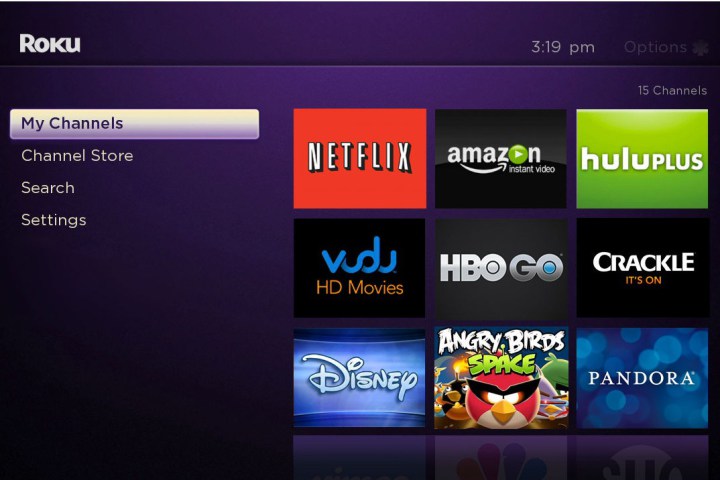
Until now, the main Roku interface has featured a row of channels which only let you see five choices at a time. Now, it sports a 3-by-3 grid, which presents nine channels at a time and lets you scroll through additional ones at a much faster clip; it wraps around, so if you sail past your last channels you arrive back at your first ones. The Channel Store looks much the same as the main screen, but with a large spot reserved for promotional space for movies and channels.

Roku’s pan-channel search feature has also been spruced up. When you search for a show or movie, it lists any channels you already have installed first, and then other channels — and you can add a channel without leaving the search results.

The one aspect of the new interface that’s very slightly flashy? The new themes, which skin the interface with custom visuals. There are five of them, such as the cloud-oriented one shown here. And even they aren’t that fancy.

Here’s another plus of Roku’s new look: you don’t need to buy a new Roku to get it. In April, the company will be rolling it out to its other models — the Roku LT, HD, 2 HD and Streaming Stick — all of which remain available.

Roku is the most-watched streaming box in the McCracken household. (Several McCracken households, actually — my non-geek parents and non-geek sister also equipped their homes with boxes, though not at my urging, and seem to be fans.) It’s fun that a small company has figured out a product category that some big companies (coughcoughGoogleTV) have failed to nail. And from what I’ve seen of the Roku 3 and the revised interface, the company has done a good job of continuing the steady-eddie approach to product evolution which has served it well to date.

Here’s Roku’s own video about the new experience:

Freelance Jobs